

Industrial flooring failure guide
Why Epoxy Floors Fail in Factories & Warehouses
Epoxy resin flooring can perform extremely well in demanding industrial
environments, but no flooring system succeeds simply because it contains epoxy.
Substrate condition, surface preparation, contamination, moisture, repairs,
system selection and application conditions can all influence performance.
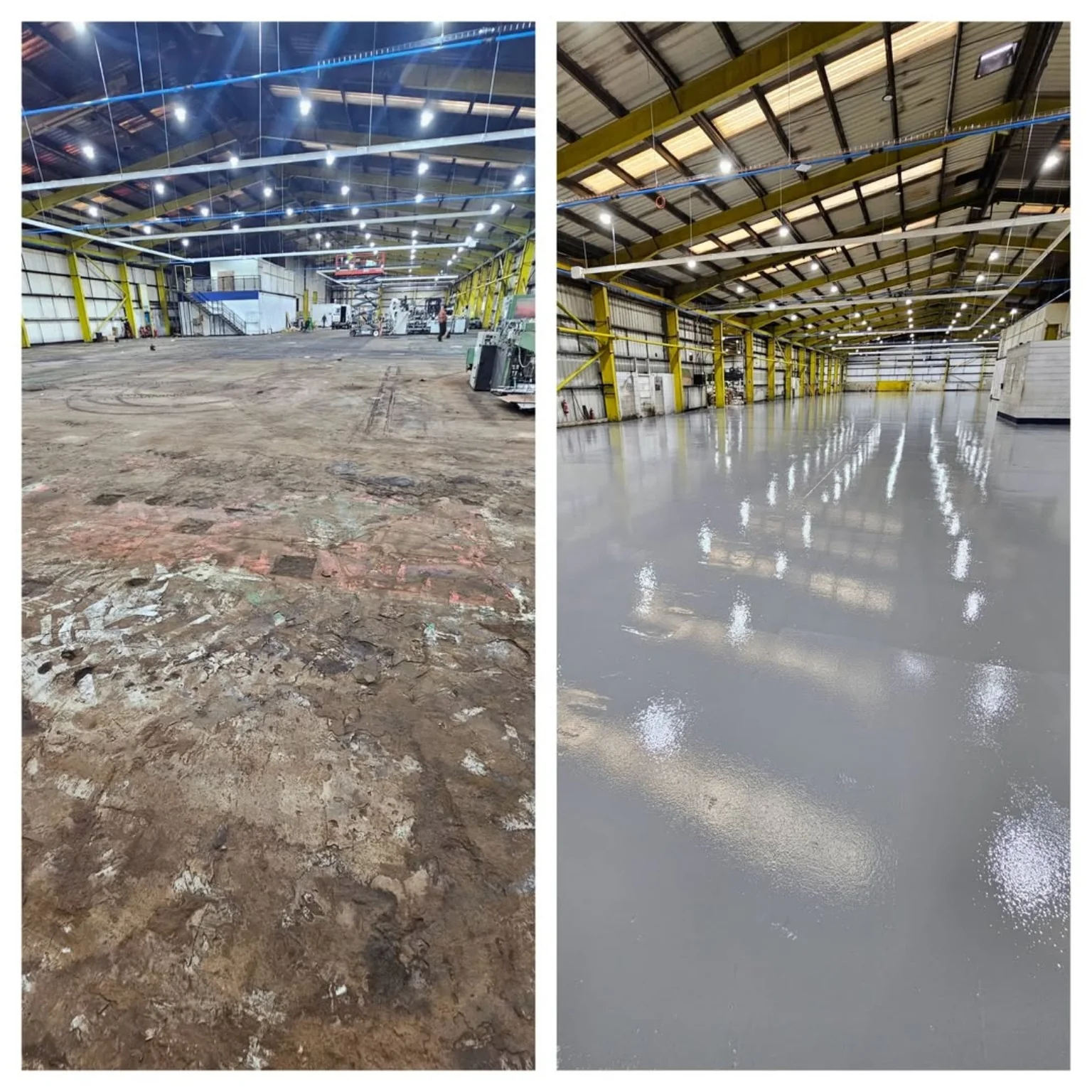
and the completed resin flooring.
Why do epoxy floors fail?
Epoxy floor problems are often linked to something within the complete flooring
build rather than the word “epoxy” itself. Poor preparation, weak or contaminated
concrete, excess moisture, unresolved cracks or defects, an unsuitable flooring
system or application outside the system requirements can all contribute to problems.
Peeling, blistering, cracking, local damage and delamination can have different
causes, so the visible defect should be investigated before deciding how the floor
should be repaired.
Common causes
Seven reasons industrial epoxy floors can fail
The finished resin surface is only one part of the flooring system. Problems
beneath or around it can affect the performance above.
Insufficient surface preparation
Concrete needs to be suitably prepared for the selected resin system.
Old coatings, laitance, weak material and contamination can interfere
with the new flooring if they are not dealt with correctly.
Oil and contamination
Factories and workshops can contain oils, grease and process contamination.
A visually clean surface does not necessarily mean contamination has been
removed from the concrete.
Moisture problems
Excess substrate moisture or moisture vapour can contribute to flooring
problems. Moisture conditions should therefore be assessed against the
requirements of the proposed flooring system.
Weak or damaged concrete
Resin flooring relies on the substrate beneath it. Weak concrete, holes,
voids and damaged areas may require removal or repair before installation.
Unresolved cracks and joints
Cracks and joints need to be assessed rather than simply hidden.
Static cracks, moving cracks and construction joints do not all behave
in the same way.
The wrong system for the duty
A thin protective coating should not automatically be expected to perform
like a heavier resin flooring system under severe traffic, impact, chemicals
or other demanding conditions.
Application and curing conditions
Temperature, substrate condition, mixing, application stages and curing
requirements should follow the selected manufacturer’s system guidance.
Cause 1
Poor surface preparation can undermine an epoxy floor
Surface preparation is one of the most important stages of an industrial
resin flooring project.
The purpose is not simply to make the existing floor look clean. Preparation
needs to create a suitable substrate for the selected flooring system while
removing weak or unsuitable material.
Depending on the project, mechanical preparation may include:
- diamond grinding
- shot blasting
- removing failed coatings
- removing weak or friable material
- edge preparation
- industrial vacuum cleaning
- opening defects so they can be assessed and repaired
FeRFA describes correct surface preparation as essential to the adhesion
of the selected resin system and to achieving its intended service life.
Read our dedicated guide to
Industrial Floor Preparation and Repairs
.
External guidance:
FeRFA Guide to Preparing Surfaces for Application of Resin Systems
.
Cause 2
Oil contamination can make industrial refurbishment more complicated
Oil contamination is particularly relevant in older factories, engineering
environments, workshops and warehouses where the concrete may have been
exposed over many years.
The problem cannot always be judged from the appearance of the floor alone.
Contamination may have penetrated the substrate, and the condition needs to
be assessed before a new resin flooring system is specified.
Simply installing another epoxy coating over a contaminated or inadequately
prepared surface does not remove the underlying issue.
A real SRS example
On SRS’s approximately 5,000m² Rhondda warehouse refurbishment, parts of the
inherited floor included oil-affected concrete alongside badly deteriorated
old resin, cracks, holes and other damage.
Mechanical preparation and repair work were therefore major parts of the
refurbishment before the new Vebro Polymers epoxy system was installed.
Read the full
5,000m² Rhondda Warehouse Resin Flooring Case Study
.
Cause 3
Moisture beneath epoxy flooring should not be ignored
Concrete can contain or transmit moisture even where the surface does not
obviously look wet.
Moisture conditions therefore need to be checked against the requirements
of the proposed primer and flooring system before installation.
Industry and manufacturer guidance identifies excess substrate moisture as
a potential cause of problems such as blistering and loss of adhesion.
Different products can also have different moisture limitations, which is
why one universal number should not be applied blindly to every resin system.
Where moisture readings are elevated, the solution depends on the substrate,
building construction and selected flooring system. A compatible moisture
control system may sometimes form part of the specification.
Cause 4
A resin floor cannot make weak concrete strong underneath
Industrial resin flooring relies on the condition of the concrete substrate.
If the concrete beneath the resin is weak or breaking down, failure can occur
within the substrate itself rather than within the visible resin coating.
This is one reason why damaged sections, voids, holes and weak concrete
should be identified during preparation.
Localised damaged areas can sometimes be cut back, cleaned and rebuilt before
the main flooring system is installed.
The correct repair route depends on the defect and the condition of the
surrounding concrete.
Cause 5
Cracks and joints need to be understood before they are coated
Not every crack in concrete behaves in the same way.
Some cracks may be stable while others can be associated with continuing
movement. Construction joints and movement joints also perform specific
functions within the slab.
A resin coating should therefore not automatically be used as a method of
simply hiding every crack or joint.
The defect should first be assessed so the repair or detailing can be chosen
around what is actually happening.
Manufacturer technical guidance for epoxy flooring systems commonly requires
existing cracks and construction joints to be assessed and treated before
the full flooring build is applied.
Cause 6
A thin epoxy coating is not the same as a heavy-duty resin floor
One of the biggest specification mistakes is treating all epoxy flooring
as though it offers the same level of performance.
The term can describe systems ranging from relatively thin protective
coatings to thicker multi-layer industrial flooring systems.
The flooring build needs to reflect the environment.
- pedestrian and pallet traffic
- forklift movements
- tight turning zones
- impact
- abrasion
- chemicals
- water and cleaning
- temperature conditions
- slip requirements
A system that performs well in a dry light-duty area may not be appropriate
for a heavily trafficked factory, loading zone or demanding production area.
Read more about
Epoxy Resin Flooring
and
Industrial Resin Flooring
.
Wear versus failure
A scratched epoxy floor has not necessarily failed
Surface scratching, scuffing or visible forklift wear does not automatically
mean that an epoxy flooring system has failed.
Industrial floors can develop cosmetic signs of use while remaining serviceable.
The important distinction is whether the issue is limited to appearance or whether
there is deeper damage, loss of adhesion or deterioration of the flooring system.
Forklift turning areas, abrasive grit and dragged equipment can all create visible
wear without necessarily indicating delamination.
Read our guides:
Do Resin Floors Scratch Easily?
and
How Durable Are Resin Floors?
.
Recognising a problem
What can epoxy floor failure look like?
Visible symptoms can include:
- peeling or flaking
- localised loss of adhesion
- blistering or bubbling
- cracks appearing through the surface
- resin breaking away around damaged concrete
- repeated failure of previous repairs
- damage around joints, thresholds and heavily trafficked areas
The appearance alone does not always identify the cause.
For example, peeling could be associated with substrate contamination,
insufficient preparation or another adhesion problem, while cracking through
the resin may relate to movement or defects within the substrate.
Investigation should therefore come before deciding whether to patch,
recoat or replace the floor.
Real industrial flooring experience
The 5,000m² Rhondda warehouse showed why preparation comes first
5,000m² Rhondda warehouse refurbishment.
The Rhondda warehouse was not a clean new slab waiting for epoxy.
SRS inherited an existing floor containing badly deteriorated resin,
oil-affected concrete, cracks, holes and damaged areas.
The work included mechanical preparation using diamond grinding and shot
blasting across suitable areas, followed by repairs using epoxy mortars
and crack-repair materials before the new resin flooring build was installed.
This is a practical example of why old industrial flooring problems should
be dealt with before the new wearing surface is applied.
The project was also phased while the manufacturer began moving machinery
and installing racking into completed areas.
Repair or replacement?
Can a failed epoxy floor be repaired?
Sometimes.
A small isolated defect may only require localised preparation and repair.
A floor with widespread loss of adhesion, extensive contamination or multiple
underlying defects may require a much larger refurbishment.
The practical sequence is:
- inspect the visible failure
- identify the extent of the affected area
- assess the substrate beneath it
- check for contamination, moisture or movement where relevant
- remove unsuitable or failed material
- complete the necessary repairs
- select a compatible flooring build for the future duty
Covering a failed surface without establishing why it failed can simply leave
the original problem underneath the new floor.
Have an epoxy floor problem?
Send SRS clear photographs before deciding on the repair
Photographs and a basic site history can help identify what needs to be checked
during the first-stage assessment.
Continue your research
Related industrial flooring information
Frequently asked questions
Epoxy floor failure FAQs
Why does epoxy flooring peel from concrete?
Peeling can have several causes, including unsuitable surface preparation,
weak concrete, contamination, moisture or another adhesion problem.
The failed area should be inspected before the cause is assumed.
Can oil cause an epoxy floor to fail?
Oil contamination can interfere with a resin flooring installation if the
substrate is unsuitable. Industrial concrete exposed to oil should be assessed
and appropriately prepared before a new system is installed.
Can moisture cause epoxy flooring to blister?
Excess substrate moisture or moisture vapour can contribute to blistering
and loss of adhesion in some resin flooring situations. Moisture conditions
should be checked against the requirements of the selected flooring system.
Does every crack mean the epoxy floor has failed?
No. The crack may originate within the concrete substrate or relate to movement
below the resin surface. The cause and type of crack should be assessed before
a repair method is chosen.
Can forklift traffic damage epoxy flooring?
Forklift traffic can create abrasion, surface marking and concentrated wear,
especially around turning areas. A suitable warehouse resin system should be
specified around the actual traffic and substrate conditions.
Can a failed epoxy floor simply be recoated?
Not always. Failed or poorly bonded material may need to be removed and the
substrate assessed first. Recoating without dealing with the original cause
can leave the underlying problem unresolved.
Is thicker epoxy always better?
No. Thickness is only one part of the specification. Resin technology,
substrate condition, preparation, traffic, impact, chemicals and the working
environment also influence performance.
How can epoxy floor failure be reduced?
Start with a sound substrate, suitable mechanical preparation, necessary
repairs, assessment of contamination and moisture, and a flooring system
selected around the site’s real operational conditions.
Industrial epoxy flooring repairs
Find the cause before covering the problem
If an existing factory or warehouse resin floor is peeling, cracking,
blistering or breaking down, send Superior Resin Solutions photographs,
the approximate area and a description of how the site is used.
We can discuss the practical next step.