


Warehouse downtime and phasing guide
Warehouse Resin Flooring Installation: Can You Stay Operational?
A warehouse resin flooring installation does not always require the whole
building to close at once. On suitable projects, preparation and resin flooring
can sometimes be divided into phases so completed areas are handed back while
work continues elsewhere. The important point is that active work zones,
prepared concrete and curing resin must remain properly segregated.
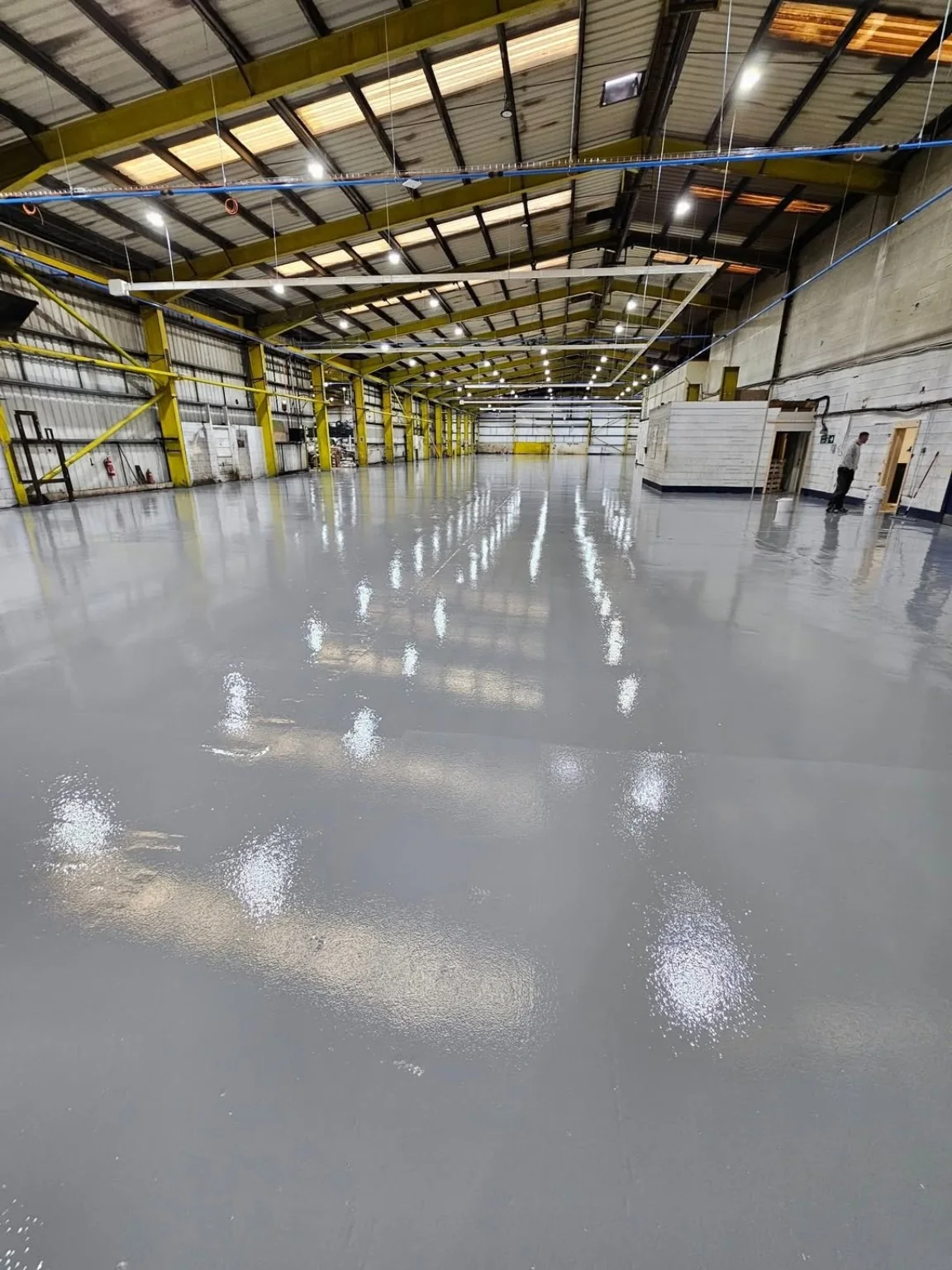
across an approximately 5,000m² industrial unit.
Can a warehouse stay operational during resin flooring installation?
Sometimes, yes. A large warehouse can potentially be divided into controlled
working zones, allowing completed sections to be returned to the client while
preparation and resin installation continue elsewhere.
That does not mean forklifts, pedestrians or machinery can continue through
the active flooring zone. Preparation areas and curing resin need to be isolated,
and each completed section should only be returned to use in accordance with
the selected system’s curing and return-to-service requirements.
Phased warehouse flooring
What does a phased warehouse resin flooring installation involve?
Phasing means dividing the overall warehouse flooring project into separate,
controlled sections rather than preparing and coating the entire building
at the same time.
A simplified programme might involve:
- agreeing the boundaries of Phase 1
- removing stock, machinery or racking where required
- isolating the flooring work zone
- mechanically preparing the concrete
- completing repairs and joint work
- installing the specified resin system
- allowing the floor to cure
- handing the completed section back
- moving the flooring team into Phase 2
The exact sequence depends on the warehouse layout, traffic routes, resin system,
repair requirements and how much uninterrupted space the business needs.
Planning around operations
Six factors that determine whether phased flooring is practical
01
Warehouse layout
Large open warehouses are often easier to divide into workable sections
than small areas with one narrow route through the building.
02
Forklift routes
Vehicle movements need to be redirected away from preparation, repair and
curing zones without creating unsafe conflicts elsewhere.
03
Racking and machinery
Fixed racking, machinery bases and equipment footprints can influence phase
boundaries and the preparation equipment that can be used.
04
Repairs
Cracks, damaged concrete, joints and previous failed repairs can extend the
programme before resin installation begins.
05
Curing time
Different resin technologies have different application and return-to-service
requirements. Manufacturer guidance should determine when each area can be used.
06
Safe segregation
Staff, contractors, vehicles and materials need clearly separated routes so
the active flooring area remains protected.
Preparation affects operations too
The disruption starts before the resin is applied
When businesses think about flooring downtime, they often focus only on how
long the resin takes to cure.
But the complete programme can also include:
- moving stock or equipment
- removing old coatings
- diamond grinding
- shot blasting
- vacuum cleaning
- crack and joint repairs
- rebuilding damaged concrete
- priming
- resin installation
- curing before handover
Mechanical preparation also requires control of the work area.
FeRFA recommends that no traffic passes over a mechanically prepared area
before the selected resin system is applied and that the prepared surface
is thoroughly vacuumed.
Return to service
How long before a warehouse floor can be used again?
There is no single curing time that applies to every resin floor.
Return-to-service time can depend on:
- resin chemistry
- system build and thickness
- product formulation
- substrate temperature
- ambient temperature
- site conditions
- type of traffic returning to the area
Pedestrian access and heavy forklift traffic may also have different
return-to-service requirements.
The manufacturer’s technical information for the selected system should
therefore determine the handover programme rather than using a generic curing
time taken from another project.
FeRFA also lists the time available for application and curing as one of the
factors that should be considered when selecting a synthetic resin flooring
system.
Restricted shutdowns
Can fast-cure resin flooring reduce warehouse downtime?
Yes, on suitable projects a rapid-cure resin system can reduce the time between
installation and return to service.
However, fast curing does not remove the need for:
- correct mechanical preparation
- concrete repairs
- joint treatment
- proper mixing and application
- safe segregation
- manufacturer curing requirements
SRS also installs MMA resin flooring for suitable projects where the available
shutdown period is particularly restricted.
MMA should not be selected purely because speed sounds attractive. The substrate,
working environment, final use, texture and complete system specification still
need to be appropriate.
Explore
MMA Fast-Cure Resin Flooring
.
Genuine SRS phased project
5,000m² Rhondda warehouse delivered in phases
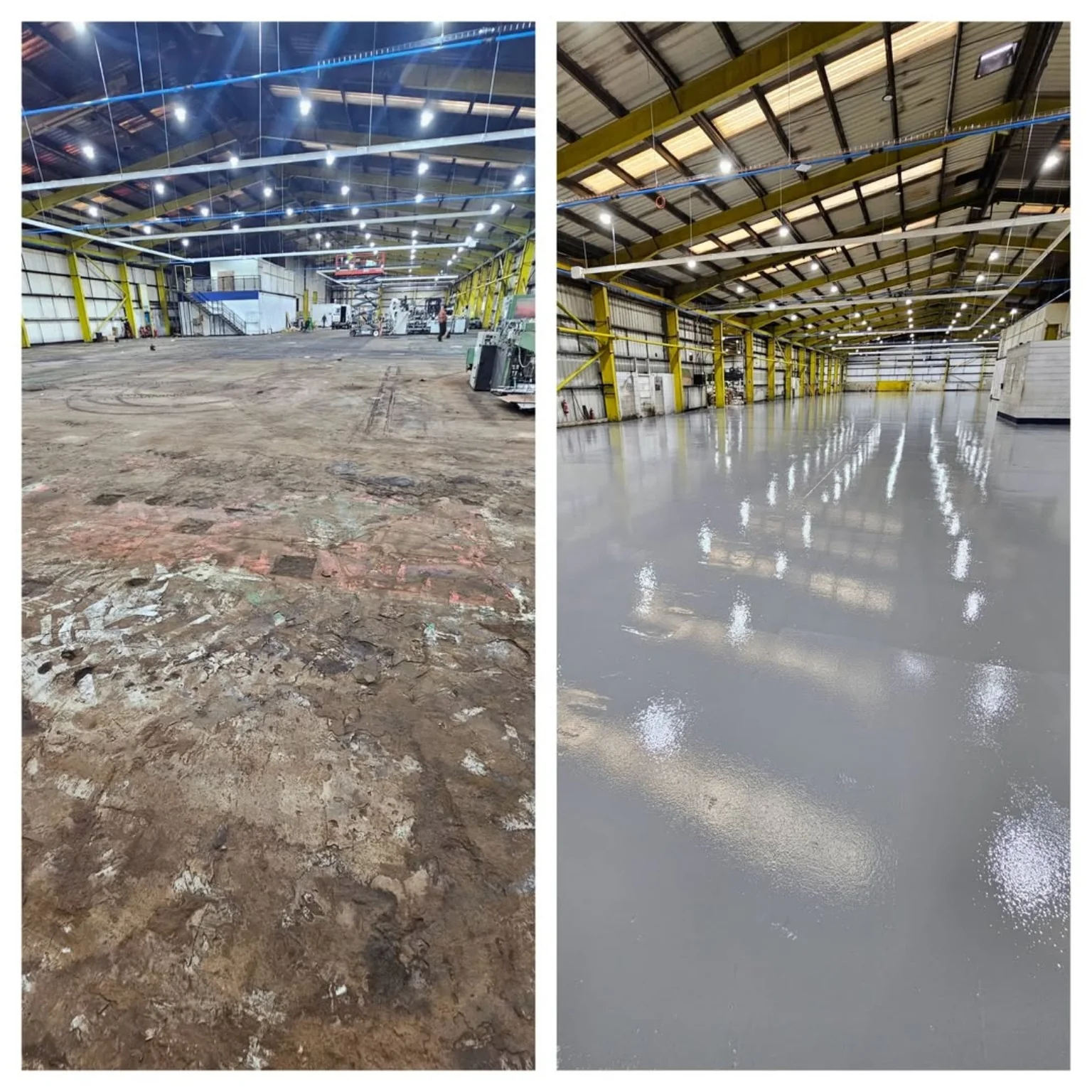
Rhondda warehouse flooring refurbishment.
A large SRS warehouse refurbishment in Rhondda demonstrates how phased flooring
can help a wider project keep moving.
The approximately 5,000m² industrial unit contained badly deteriorated old
resin, oil-affected concrete, cracks, holes and other damaged areas.
SRS used diamond grinding and shot blasting across suitable areas before
completing extensive concrete and epoxy repairs and installing the specified
Vebro Polymers epoxy flooring system.
The complete flooring programme was delivered in phases over approximately
two weeks.
After Phase 1 was completed and handed over, the manufacturer began moving
machinery into the finished area and installing racking while SRS continued
with Phase 2.
This is an important distinction: the active flooring zone still needed to
remain controlled, but handing back completed areas allowed the customer’s
wider warehouse setup programme to continue.
Read the full
5,000m² Rhondda Warehouse Resin Flooring Case Study
.
Not every warehouse can stay open
When might a full shutdown still be the better option?
Phased installation is useful, but it should not be forced onto a project
where it creates unnecessary risk or inefficiency.
A wider shutdown may be more practical where:
- the warehouse has only one essential vehicle route
- machinery cannot be moved or safely isolated
- the entire slab requires extensive repairs
- contamination is widespread
- phase boundaries would create poor flooring details
- safe pedestrian or forklift routes cannot be maintained
- the cost of repeated mobilisation outweighs the operational benefit
Sometimes a shorter complete closure can be more efficient than stretching
the work across numerous small phases.
Programme options
Weekend and out-of-hours warehouse flooring
Another way to reduce disruption can be to programme suitable stages around
planned shutdowns, weekends or quieter operating periods.
Whether that is practical depends on the amount of preparation and repair work,
the flooring system and the curing period available before normal operations resume.
A short closure window does not automatically mean the project can be completed
within that period.
If extensive coating removal, repairs or contaminated concrete are discovered,
the preparation stage itself can become the dominant part of the programme.
For this reason, the shutdown window should be discussed during the initial
floor assessment rather than after a flooring system has already been selected.
Warehouse traffic
When can forklifts return to a newly installed resin floor?
Forklifts should only return when the selected resin system has reached the
manufacturer’s required condition for the intended traffic.
Heavy loaded vehicles can place much greater stress on a new floor than
pedestrian traffic.
Turning points, loading areas and narrow aisles can also create concentrated
wear and loading.
The return-to-service plan should therefore identify what type of traffic
will use the completed phase rather than simply asking when the floor can
be walked on.
Read our guide:
Best Flooring for Warehouses With Forklift Traffic
.
Planning the phases
Where should warehouse flooring phase boundaries be placed?
Phase boundaries should be planned around the building and the flooring
system rather than chosen simply because a line is convenient on a drawing.
Considerations can include:
- existing joints
- doorways
- aisles
- racking layouts
- machinery positions
- loading areas
- pedestrian routes
- forklift routes
- areas that can be completely cleared
A clear phasing plan can also help the client organise stock movements,
equipment relocation and internal access before the flooring team arrives.
Cost and programme
Does phased warehouse resin flooring cost more?
It can, depending on how the project is divided.
Multiple phases can potentially require:
- additional mobilisation
- repeated protection and segregation
- more edge or phase detailing
- additional cleaning between stages
- smaller working areas
- more coordination with warehouse operations
However, the flooring cost should also be considered against the business
impact of shutting down the complete warehouse.
For some facilities, keeping part of the site available can be commercially
valuable even if the installation programme becomes more complex.
Read our
Resin Flooring Cost Guide
.
Need to keep your warehouse moving?
Tell SRS the shutdown restrictions before the flooring system is chosen
These details help establish whether phasing, weekend works, fast-cure flooring
or a wider shutdown should be assessed.
Continue your research
Related warehouse flooring information
Frequently asked questions
Warehouse resin flooring installation FAQs
Can a warehouse remain open while resin flooring is installed?
Sometimes. Large warehouses can potentially be divided into separate phases
so completed areas are handed back while flooring works continue elsewhere.
The active flooring zone must still remain safely segregated.
Can forklifts drive through the flooring work area?
No. Active preparation and resin flooring areas need to remain protected from
warehouse traffic. Forklift routes should be redirected around the controlled zone.
How long does warehouse resin flooring take to cure?
There is no single curing time for all resin floors. The product, resin chemistry,
system thickness, temperature and intended traffic all affect return to service.
The selected manufacturer’s technical data should be followed.
Can warehouse flooring be installed over a weekend?
Some projects can be planned around weekend shutdowns, but preparation, repairs,
installation and curing all need to fit the available window. The existing
floor condition should be assessed before committing to the programme.
Is MMA flooring suitable when downtime is limited?
MMA is a rapid-cure resin flooring option that can be considered for suitable
low-downtime projects. The substrate, environment and required performance
still need to suit the selected system.
Can a warehouse floor be installed in several phases?
Yes, where the layout and operation allow it. Phase boundaries, access routes,
traffic, racking, machinery and curing requirements should all be planned before
work starts.
Does phased resin flooring cost more?
It can because multiple phases may require additional mobilisation, protection,
segregation and detailing. This should be weighed against the commercial impact
of closing the entire warehouse.
Has SRS completed phased warehouse flooring projects?
Yes. SRS completed an approximately 5,000m² Rhondda warehouse refurbishment
in phases over two weeks. The client began moving machinery and installing
racking in completed Phase 1 areas while SRS continued with Phase 2.
Warehouse flooring programme
Plan the shutdown and flooring system together
Send Superior Resin Solutions your warehouse floor area, existing condition,
operating hours, forklift routes, machinery layout and available shutdown
window. We can discuss whether phased installation, standard resin systems
or a fast-cure route should be assessed.