

Warehouse flooring specification guide
Best Flooring for Warehouses With Forklift Traffic
Forklifts place very different demands on a warehouse floor from ordinary
pedestrian traffic. Vehicle weight, wheel type, turning movements, loading,
abrasive debris and the condition of the concrete all influence which resin
flooring system is appropriate.
What is the best flooring for a warehouse with forklifts?
There is no single flooring system that is automatically best for every
warehouse. In many dry warehouse and distribution environments, a correctly
specified epoxy resin system can provide a practical, hard-wearing surface.
Heavier-duty, wet, thermally demanding or highly abrasive areas may require
a different resin build, polyurethane screed or another specialist system.
The important point is to select the floor around the actual forklift traffic,
turning areas, substrate condition, contamination, cleaning, slip risk and
shutdown period rather than choosing a coating based on appearance alone.
Reviewed for practical accuracy by Richard Evans, Director,
Superior Resin Solutions UK Ltd.
Understanding warehouse traffic
Why forklift traffic is demanding on warehouse floors
A forklift does not apply one consistent level of wear across an entire
warehouse. The most demanding areas are often concentrated around routes,
turns, loading points and operational zones.
Turning forces
Tight forklift turns can create concentrated forces and visible wear,
particularly where vehicles repeatedly rotate in the same areas.
Vehicle and load weight
The weight of the forklift and the loads being carried should be considered
when determining the duty expected from the floor.
Wheel and tyre type
Different wheel materials and contact areas can create different wear
patterns, particularly across frequently travelled routes.
Abrasive contamination
Grit, debris and contamination can become trapped beneath wheels and
accelerate scratching or abrasion of the floor surface.
Impact and dropped loads
Pallets, tools, components and materials can create local impact damage
that ordinary pedestrian flooring would not normally experience.
Existing concrete
Weak, damaged or contaminated concrete can undermine the new resin system
if defects are not identified and treated before installation.
Choosing the flooring system
Which warehouse flooring systems suit forklift traffic?
The correct route depends on the warehouse rather than the product name.
The table below shows the types of conditions that can influence system choice.
| Warehouse condition | Possible flooring route | What must be checked |
|---|---|---|
| Dry warehouse with regular forklift traffic | Suitable industrial epoxy resin flooring system | Traffic frequency, wheel type, turning zones, abrasion and substrate condition |
| Loading bays, entrances or higher slip risk | Textured or broadcast resin finish | Contamination, cleaning method, footwear, drainage and required slip resistance |
| Heavy industrial or impact-prone areas | Heavier resin build or specialist industrial system | Impact, loading, machinery, floor condition and expected duty |
| Wet, hot or hygiene-sensitive processing | Polyurethane screed may be considered | Temperature, washdown, chemicals, hygiene and system manufacturer guidance |
| Very short shutdown window | Fast-cure resin systems such as MMA may be considered | Substrate condition, preparation, ventilation, curing and operational programme |
| Badly damaged or contaminated slab | Preparation and repairs before the final flooring system | Old coatings, oils, cracks, holes, weak concrete, joints and moisture |
Epoxy warehouse flooring
Is epoxy flooring suitable for forklifts?
Epoxy resin flooring is widely used in warehouses because suitable industrial
systems can provide a hard, seamless and practical working surface.
However, the word epoxy does not describe one standard floor.
A relatively thin coating and a heavier-duty multi-layer system are not designed
to perform under identical conditions.
Forklift frequency, vehicle weight, wheel type, turning behaviour, impact,
abrasion and the condition of the concrete should all influence the specification.
For more information about the system itself, see our
Epoxy Resin Flooring
page.
Why turning zones deserve particular attention
The floor beneath a forklift route does not always wear evenly. Straight travel
routes can behave differently from locations where forklifts brake, rotate,
reverse or repeatedly turn within a tight space.
That is why racking ends, loading areas, doorways and busy intersections should
be reviewed during the flooring survey rather than treating the warehouse as one
uniform square metre area.
Our guide
Do Resin Floors Scratch Easily?
explains how forklift turning, grit and other abrasive conditions can affect
the visible surface.
The concrete beneath the resin
Preparation can matter as much as the resin system
Warehouse resin flooring depends on the substrate underneath it. Installing a
stronger coating over weak, contaminated or poorly bonded material does not
remove the underlying problem.
Existing warehouse floors may contain:
- old or failing resin coatings
- weak or worn concrete
- oil contamination
- cracks and damaged joints
- holes and impact damage
- previous repairs
- surface contamination and embedded debris
Mechanical preparation can include methods such as diamond grinding or shot
blasting depending on the substrate, existing finish and selected flooring system.
FeRFA’s surface-preparation guidance identifies correct preparation as essential
to achieving adhesion and the intended life of the resin system.
Read more about
Industrial Floor Preparation and Repairs
.
Independent industry guidance
Warehouse flooring should be selected around the actual duty
FeRFA’s guidance on synthetic resin flooring recommends considering the type,
extent and frequency of traffic as part of the flooring selection process.
It also identifies loading, impact, chemicals, temperature, slip resistance,
expected lifespan, flooring thickness, installation and curing time, and the
age and condition of the substrate as relevant specification factors.
That supports a simple principle: the best warehouse floor is the system that
matches the real warehouse rather than the system with the most impressive
product description.
View
FeRFA’s Guide to the Selection of Synthetic Resin Flooring
.
Genuine SRS warehouse project
5,000m² Rhondda warehouse: the substrate had to be dealt with first
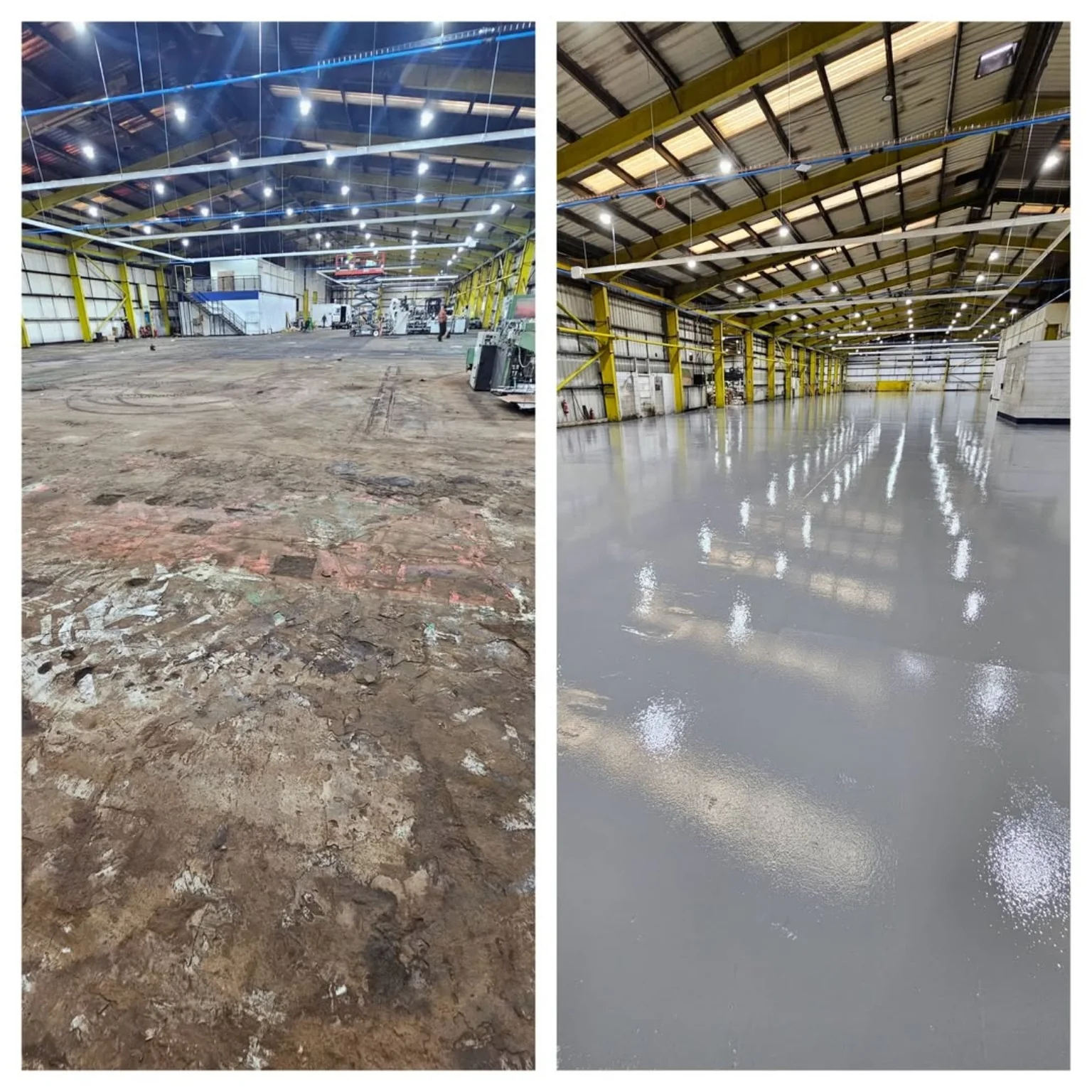
A useful SRS example is the approximately 5,000m² warehouse refurbishment
completed for a South Wales manufacturer in Rhondda.
The inherited floor contained badly deteriorated old resin, oil-affected
concrete, cracking, holes and damaged areas. This meant the project was not
simply a case of applying a new coating over the existing surface.
Diamond grinding and shot blasting were used across suitable areas. Damaged
sections were repaired with epoxy mortars before the new Vebro Polymers epoxy
flooring system was installed.
The programme was also phased so the manufacturer could begin moving machinery
and installing racking in completed areas while SRS continued the remaining works.
Read the full
5,000m² Rhondda Warehouse Resin Flooring Case Study
.
Another genuine SRS warehouse project
3,500m² Bristol warehouse refurbishment
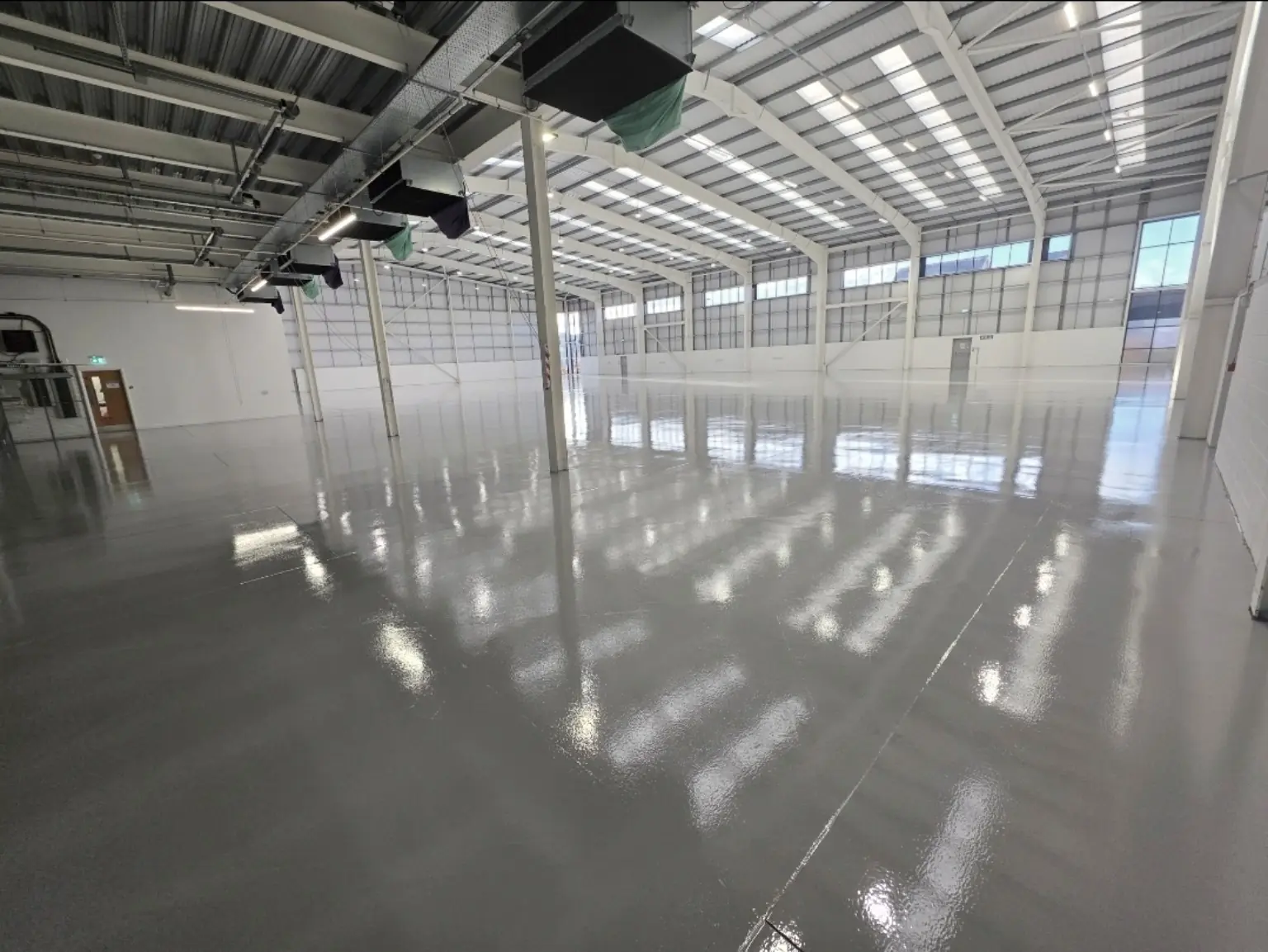
SRS also completed an approximately 3,500m² warehouse resin flooring project
in Bristol where the existing floor was old, tired and damaged.
The floor was mechanically prepared using diamond grinding and shot blasting.
Indentations and damaged areas extending into the concrete were cleaned and
rebuilt with epoxy mortar before the new Vebro Polymers epoxy system was installed.
Again, the finished resin surface was only one part of the job. Preparation,
repairs and system selection were all part of producing a floor suitable for
the warehouse environment.
View the
3,500m² Bristol Warehouse Resin Flooring Case Study
.
Grip and warehouse safety
Does forklift flooring need an anti-slip finish?
Anti-slip texture should be selected around the actual slip risk rather than
simply added to every warehouse floor.
Entrances, loading areas, ramps, wet zones and locations exposed to contamination
may have different requirements from clean, dry storage aisles.
A more textured finish can also affect cleaning, so slip resistance and
cleanability need to be considered together.
Learn more about
Anti-Slip Resin Flooring
.
Programme and disruption
Warehouse downtime can affect the flooring decision
A technically suitable flooring system also needs to fit the operational
programme.
A warehouse may need flooring completed around racking, machinery, stock,
pedestrian routes or phased shutdowns. Preparation and curing still require
enough time, even where the installation is divided into separate working zones.
Where very rapid return to service is necessary, a
fast-cure MMA flooring system
may be considered where technically appropriate.
The Rhondda project is a useful example of phased installation: completed areas
were released for machinery and racking installation while the remaining
flooring works continued.
Budgeting for warehouse flooring
What affects the cost of forklift-resistant warehouse flooring?
Floor area matters, but it is only one part of the quotation.
Cost can also be affected by:
- existing coatings and their removal
- diamond grinding or shot blasting
- concrete repairs
- oil or other contamination
- cracks and damaged joints
- system type and thickness
- anti-slip requirements
- line marking and demarcation
- restricted access or phased working
- the available shutdown window
For a fuller explanation, read our
Resin Flooring Cost Guide
.
Planning a warehouse floor?
Information that helps SRS assess forklift flooring
A good first-stage brief makes it easier to understand the likely
preparation and flooring route.
Continue your research
Warehouse and industrial flooring information
Frequently asked questions
Warehouse flooring and forklift FAQs
What is the best warehouse flooring for forklifts?
There is no single best system for every warehouse. A suitable industrial
epoxy system may work well in many dry warehouse environments, while
heavier-duty, wet, hot or highly demanding areas can require a different
resin system. Traffic, substrate condition, impact, contamination and
downtime should all be assessed.
Is epoxy flooring strong enough for forklifts?
Suitable epoxy flooring systems can be specified for forklift traffic.
The exact build should reflect vehicle weight, wheel type, frequency,
turning areas, abrasion and the condition of the concrete substrate.
Why do forklift turning areas wear faster?
Repeated braking, turning and rotation can create concentrated wear
compared with straight travel. These zones should be considered when
surveying and specifying the warehouse floor.
Can damaged warehouse concrete be resin coated?
Often the concrete can be repaired and refurbished, but the damage must
first be assessed. Weak areas, holes, cracks, failed coatings and
contamination may require preparation and repair before the final resin
system is installed.
Does warehouse resin flooring need to be anti-slip?
Slip resistance should be based on the actual environment. Loading bays,
entrances, ramps and wet or contaminated areas may require different
surface characteristics from clean, dry warehouse aisles.
Can a warehouse stay operational during flooring work?
Some projects can be phased so completed areas return to use while work
continues elsewhere. The feasibility depends on access, safe segregation,
preparation, curing, traffic routes and the selected flooring system.
Does thicker resin flooring always mean better forklift resistance?
Thickness is important but does not determine performance on its own.
Resin technology, preparation, substrate quality, traffic, impact and
operating conditions also influence how the floor performs.
How much does warehouse resin flooring cost?
The cost depends on more than the floor area. Preparation, repairs,
contamination, system type, thickness, access, slip requirements and
the installation programme can all affect the quotation.
Warehouse resin flooring
Specify the floor around the forklifts, not just the square metres
Send Superior Resin Solutions photographs of the existing floor,
approximate area, forklift details, current damage and available shutdown
period. We can review the information and discuss the practical flooring route.