

Industrial floor contamination guide
Can Resin Flooring Be Installed Over Oil-Contaminated Concrete?
Resin flooring over oil contaminated concrete can sometimes be possible,
but the contamination should not simply be hidden beneath a new coating.
The concrete needs to be assessed to establish the extent of the problem,
prepared or treated as required and confirmed as suitable for the selected
resin flooring system.
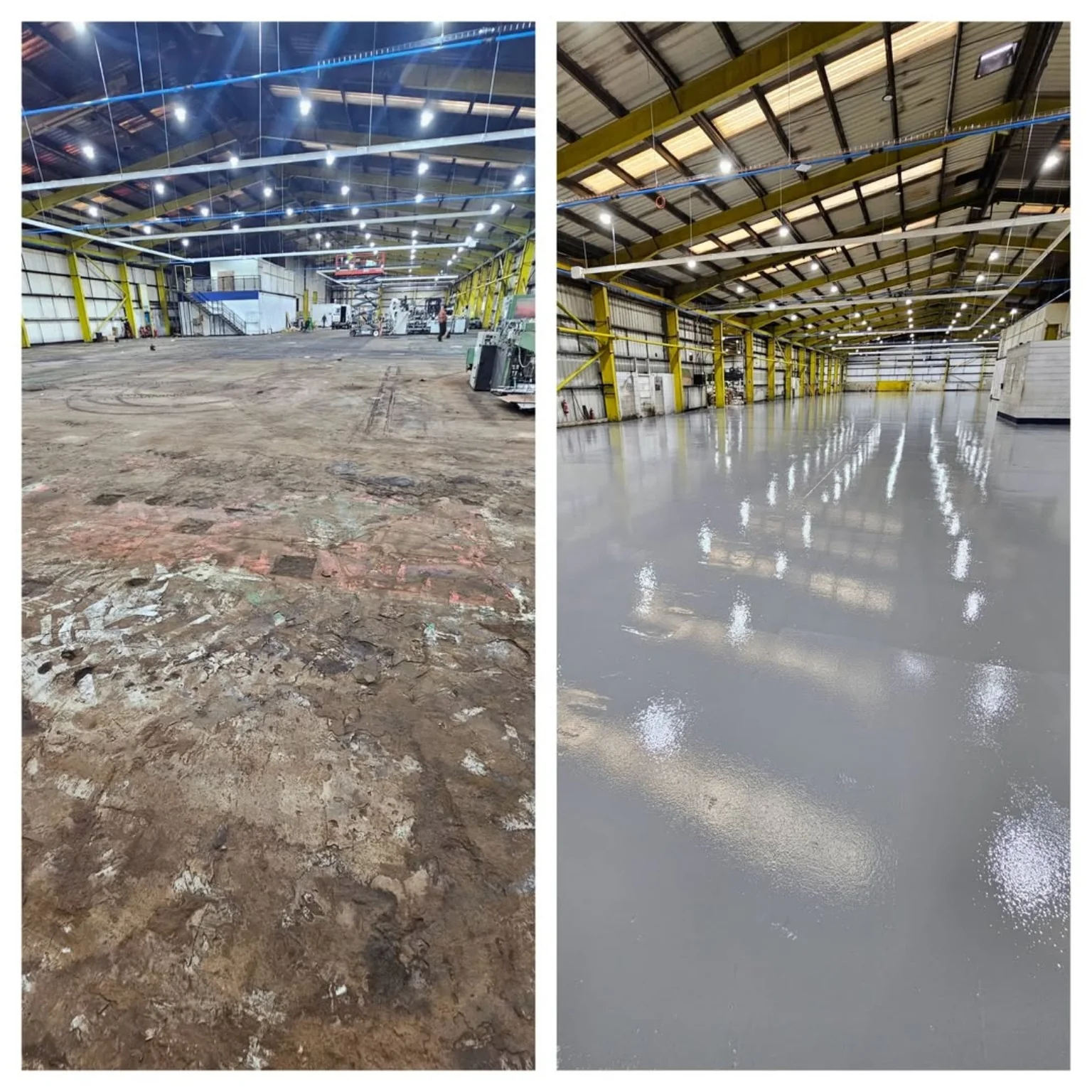
damaged resin flooring and extensive preparation.
Can resin flooring go over oil-contaminated concrete?
Potentially, but only after the contamination and substrate have been properly
assessed. Oil, grease and similar contaminants can interfere with the bond
between the concrete and a new resin flooring system.
Light surface contamination and oil that has penetrated deeply into the slab
are not necessarily the same problem. Some floors can be refurbished following
suitable preparation, while more severely affected areas can require additional
treatment, deeper removal or localised repairs.
Why contamination matters
Why oil can cause problems beneath resin flooring
A resin flooring system needs a suitable surface to bond to. Oil trapped
within concrete can interfere with that bond if it is not dealt with before
installation.
01
Reduced adhesion
Oil or grease at the bonding surface can prevent the primer or resin system
from properly wetting and bonding to the concrete.
02
Contamination below the surface
Industrial oils can penetrate concrete pores, meaning the visible surface
does not always reveal the full extent of the contamination.
03
Old coatings can hide the problem
Existing paint or resin flooring can conceal oil-affected concrete until
mechanical preparation begins.
04
Contamination can be localised
A machinery position may be heavily affected while neighbouring sections
of the slab remain in much better condition.
05
The source may still be active
Workshops and factories can experience continued leaks or spills. The source
of the contamination should be addressed before refurbishment where possible.
06
The flooring specification matters
Specialist treatments and primers exist for some contaminated substrates,
but their suitability depends on the exact flooring system and manufacturer
guidance.
Assessment first
Resin Flooring Over Oil Contaminated Concrete: What Needs Checking?
Resin flooring over oil contaminated concrete requires more investigation
than installing resin onto a clean new slab. The extent of contamination,
concrete condition, previous coatings and proposed resin system all need to
be considered before installation.
Useful information can include:
- how long the concrete has been exposed to oil
- the type of oil or process contamination if known
- whether leaks are still occurring
- whether an existing coating is present
- where machinery, vehicles or storage areas have been located
- whether contamination is localised or widespread
- the condition and strength of the concrete
- any cracks, holes, joints or previous repairs
Mechanical preparation can reveal conditions that were not obvious while
an old coating was still in place.
The important point is that the floor should be investigated before deciding
what preparation and resin system are appropriate.
Preparation options
How is oil-contaminated concrete prepared for resin flooring?
There is no single preparation method that suits every contaminated floor.
The correct approach depends on the depth and type of contamination, the
concrete condition and the flooring system being installed.
Depending on the project, preparation can involve a combination of:
- specialist cleaning or degreasing
- diamond grinding
- shot blasting
- removal of contaminated surface concrete
- repeated preparation where contamination remains
- repairing damaged or removed sections
- manufacturer-approved decontamination treatments
- compatible primers selected for the substrate condition
A floor looking visually clean after washing does not necessarily prove that
oil contamination has been removed from the concrete.
Mechanical preparation can therefore be important because it exposes the
actual substrate and allows the condition to be reassessed.
Mechanical preparation
Can grinding or shot blasting remove oil contamination?
Diamond grinding and shot blasting can remove coatings, weak surface material
and contaminated surface concrete.
However, oil can penetrate deeper than the immediate surface.
If contamination remains following the first preparation stage, further
mechanical preparation, treatment or localised removal may be necessary.
This is why the floor should be checked as preparation progresses rather
than assuming one machine pass has solved the issue.
Read our guide:
Diamond Grinding vs Shot Blasting Before Resin Flooring
.
Primer selection
Can a specialist primer solve an oil-contamination problem?
Specialist primers and treatment systems are available for some contaminated
substrates, but they should not be viewed as a universal shortcut around
proper preparation.
A primer is part of the flooring system. It does not automatically make
heavily contaminated concrete suitable for resin flooring.
Where a specialist system is being considered, the manufacturer should define:
- how the concrete is prepared
- what cleaning or treatment is required
- which primer is compatible
- application conditions
- limitations of the treatment
- which flooring systems can be installed afterwards
The complete system should therefore be considered rather than selecting
a primer in isolation.
Genuine SRS project
5,000m² Rhondda warehouse with oil-affected concrete
5,000m² Rhondda warehouse refurbishment.
SRS encountered oil-affected concrete during an approximately 5,000m²
warehouse resin flooring refurbishment in Rhondda.
The inherited floor also contained badly deteriorated old resin, cracking,
holes and other damaged areas.
This meant the project could not simply be treated as a straightforward
recoat.
Mechanical preparation was completed across the floor, with diamond grinding
and shot blasting used in suitable areas.
Damaged sections were repaired using epoxy mortar and crack-repair materials
before installation of the new Vebro Polymers epoxy flooring system.
The project is a useful real-world example of why resin flooring over oil
contaminated concrete should be approached as a substrate-preparation issue,
not simply a coating choice.
Read the full
5,000m² Rhondda Warehouse Resin Flooring Case Study
.
Where contamination is commonly found
Which industrial floors are most likely to contain oil contamination?
Oil-affected concrete can be found across many long-established industrial
environments.
Examples include:
- engineering workshops
- vehicle workshops
- factories
- machinery areas
- maintenance bays
- warehouses with vehicle servicing
- production facilities
- areas beneath old machinery
The risk can be higher where bare concrete was exposed for long periods or
where an old coating had already broken down.
Machinery footprints can also reveal contamination only after equipment
has been moved during refurbishment.
Severe contamination
What if the oil has penetrated deeply into the concrete?
Some floors are much more heavily contaminated than others.
Where contamination remains within weak or unsuitable concrete, simply
cleaning the visible surface may not provide a suitable substrate.
Depending on the actual condition, the refurbishment route may involve:
- deeper mechanical preparation
- removal of localised contaminated concrete
- rebuilding damaged areas
- specialist treatment products
- another manufacturer-approved preparation route
The correct decision should be based on the condition of the slab after
assessment and preparation.
Avoiding premature failure
Oil contamination can contribute to resin flooring adhesion problems
Oil contamination can interfere with adhesion, but it is not the only
possible cause of a resin flooring problem.
Other issues can include:
- insufficient mechanical preparation
- weak concrete
- moisture
- unresolved cracks or joints
- an unsuitable flooring build
- incorrect application conditions
- curing conditions outside system requirements
A peeling or delaminated floor should therefore be investigated before
assuming contamination is responsible.
Budget implications
Does oil contamination increase resin flooring cost?
It can.
A clean and sound concrete slab may require a simpler preparation programme
than a floor containing oil penetration, failed coatings and damaged concrete.
Additional costs can come from:
- specialist cleaning
- extra grinding or blasting
- removal of contaminated concrete
- additional waste disposal
- repairs following removal
- specialist primers or treatment products
- additional labour and preparation stages
This is why industrial resin flooring quotations should consider the existing
floor condition rather than relying only on a simple square-metre rate.
Read our
Resin Flooring Cost Guide
.
Have an oil-contaminated floor?
Send SRS photographs before deciding the flooring route
The more information available about the existing floor, the easier it is
to identify what needs to be checked during the first-stage assessment.
Continue your research
Related industrial flooring information
Frequently asked questions
Oil-contaminated concrete and resin flooring FAQs
Can epoxy flooring be installed over oily concrete?
The floor should not simply be coated while oil remains at the bonding
surface. The contamination should be assessed and the concrete suitably
cleaned, prepared, treated or repaired before a compatible flooring system
is installed.
Can resin flooring over oil contaminated concrete be successful?
It can be possible where the contamination has been properly assessed and
the substrate has been prepared to a condition suitable for the selected
flooring system. Heavily contaminated floors can require more extensive
preparation or localised removal.
Does diamond grinding remove oil from concrete?
Grinding can remove contaminated surface concrete, but oil may have penetrated
deeper. The substrate should be reassessed after preparation to determine
whether additional treatment or removal is necessary.
Can shot blasting remove oil contamination?
Shot blasting can remove contaminated surface material, but deeper oil
penetration may remain. Additional preparation or specialist treatment can
therefore still be required.
Can oil cause epoxy flooring to peel?
Oil contamination can interfere with adhesion and may contribute to peeling
or delamination. Other causes are also possible, so the substrate and failed
floor should be investigated before the cause is assumed.
Can oil-contaminated concrete be repaired rather than replaced?
Localised areas can often be prepared, treated or repaired, but heavily
contaminated or weak concrete may need more extensive removal. The appropriate
route depends on the condition found during preparation.
Does oil contamination make resin flooring more expensive?
It can because extra cleaning, mechanical preparation, repairs, treatment
products and labour may be required before the final flooring system can
be installed.
Should leaks be fixed before the new resin floor is installed?
Where possible, ongoing sources of oil or process contamination should be
addressed before refurbishment. Repeated contamination can create new
maintenance and cleaning problems even after the flooring has been replaced.
Industrial floor contamination
Deal with the contamination before asking the new resin floor to bond
Send Superior Resin Solutions photographs, approximate floor area, existing
coating, contamination history and details of how the facility is used.
We can discuss the likely preparation, repair and flooring route.