


Food factory flooring comparison
PU Screed vs Epoxy Flooring for Food Factories
When comparing PU screed vs epoxy flooring for a food factory, the right
choice depends on how the area is actually used. Wet processing, hot washdown,
chemicals, fats, food acids, hygiene, drainage, impact and traffic can all make
the flooring demands very different from those in a dry packing or storage area.
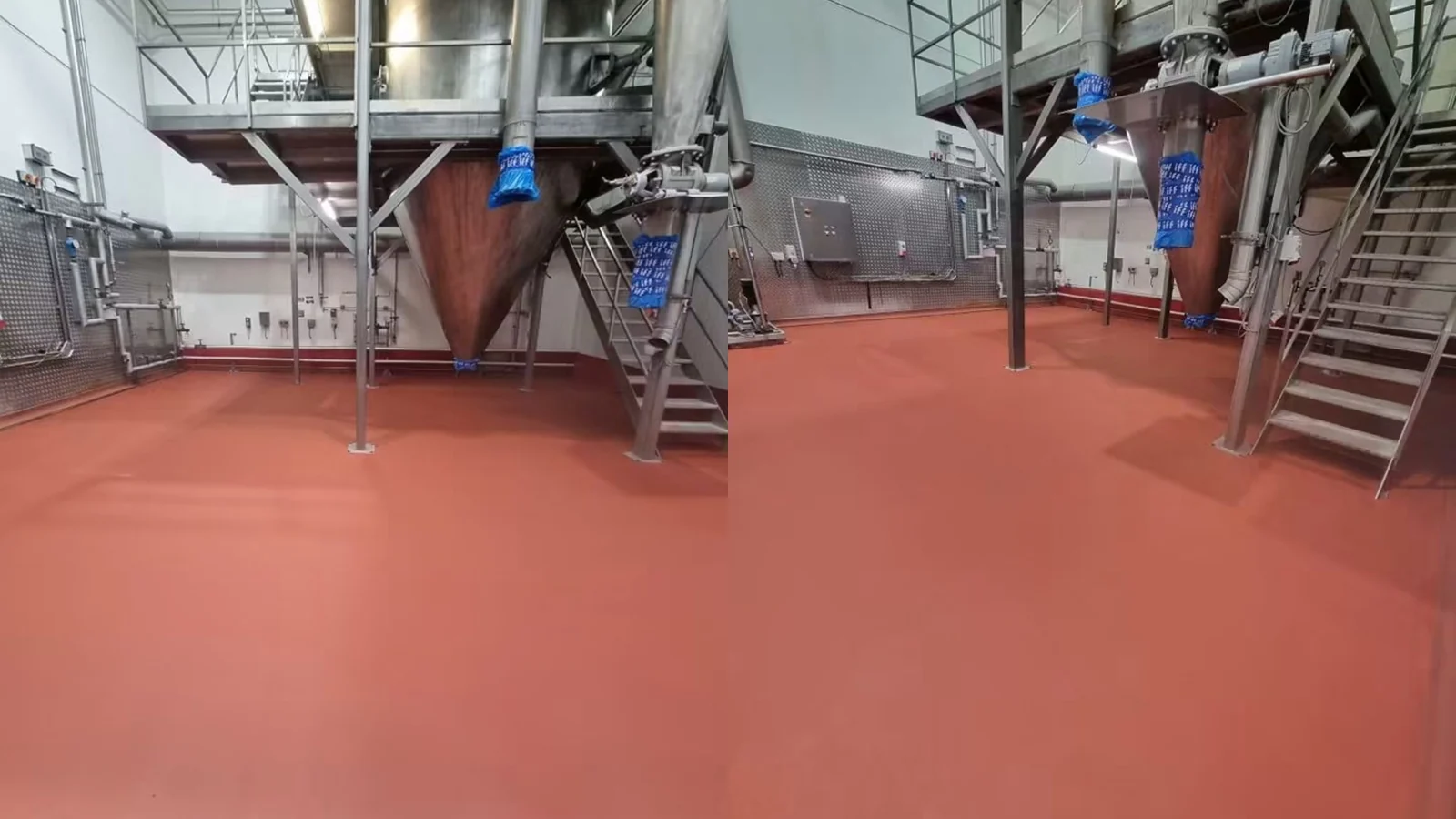
6–9mm Resdev Pumadur HF.
PU screed or epoxy for a food factory?
In demanding wet, hot-wash and hygiene-sensitive production areas, heavy-duty
PU screed is often the more suitable resin flooring route because the system is
designed around combinations of temperature, water, chemicals, impact and cleaning.
Epoxy flooring can still be appropriate in suitable dry production, storage,
packing or lower-temperature areas where those severe operating conditions are
not present.
The facility should therefore be divided into operational zones rather than
assuming one flooring system is automatically best for every room.
Quick comparison
PU screed vs epoxy flooring at a glance
| Condition | Epoxy flooring | PU screed |
|---|---|---|
| Dry packing or storage areas | Can be suitable when correctly specified | May be more than the area requires |
| Wet processing | Depends on system and exposure | Often considered for demanding wet environments |
| Hot washdown | Product limitations must be checked carefully | Heavy-duty systems are commonly selected for higher thermal demands |
| Chemical exposure | Depends on chemical type, concentration and system | Heavy-duty PU screeds are commonly used where process chemicals are demanding |
| Heavy impact | Build and thickness matter | Heavy-duty screed build can suit more demanding impact conditions |
| Hygiene-sensitive production | Seamless epoxy can suit selected areas | Commonly used in heavy-duty food-processing environments |
Food production conditions
Why food factory floors can be unusually demanding
Hot water
Regular hot-water cleaning and process temperatures can place thermal stress
on a flooring system.
Chemicals
Cleaning chemicals, food acids, fats, oils and other process materials can
affect insufficiently resistant flooring.
Water
Wet processing, washdown and drainage create different flooring demands from
a dry warehouse or packing room.
Hygiene
Seamless surfaces, coving, drainage interfaces and effective cleaning all
form part of the flooring specification.
Traffic and impact
Trolleys, pallet trucks, production equipment and dropped items can place
significant mechanical demands on the floor.
Slip risk
Water, fats and contamination can increase slip risk, requiring texture to
be balanced against cleanability.
Epoxy flooring
Where epoxy flooring can still work well in food facilities
Epoxy should not be dismissed simply because a site handles food.
Food factories often contain several different operating zones.
Suitable epoxy systems may be considered in areas such as:
- dry storage rooms
- packing areas
- dry production zones
- corridors
- warehouses
- selected back-of-house spaces
The key is understanding what actually reaches the floor.
Where the area is mainly dry and temperatures are moderate, a correctly
specified epoxy system may provide a practical and durable surface.
Read more about
Epoxy Resin Flooring
.
Heavy-duty polyurethane flooring
Where PU screed becomes the stronger candidate
PU screed is commonly selected when several demanding conditions occur together.
These can include:
- regular hot-water washdown
- wet processing
- high chemical exposure
- food oils, fats and acids
- heavy trolleys and production traffic
- impact
- hygiene-sensitive processing
- floor drains and coving requirements
PU screed is a polyurethane-cement flooring system rather than a thin
polyurethane coating.
The heavy-duty build is one reason it is widely used in food and beverage
production, commercial kitchens and other demanding processing environments.
Learn more about
Polyurethane Screed Flooring
.
Temperature exposure
Why hot washdown matters when choosing food factory flooring
Temperature is one of the major differences between a typical dry industrial
floor and many food-processing areas.
A floor can be exposed to hot cleaning water, steam, heated processing
equipment or rapid temperature changes during cleaning.
That rapid change is often referred to as thermal shock.
Flowcrete identifies thermal shock as a particular flooring challenge within
food and beverage facilities and notes that steam cleaning, hot equipment and
cold-store transitions can create sudden temperature changes.
This does not mean every PU screed automatically withstands every temperature.
The selected product thickness and manufacturer’s written temperature limits
must still be followed.
Chemical exposure
Cleaning chemicals and food by-products can affect the floor
Food factory flooring can come into contact with more than water.
Depending on the process, exposure may include:
- cleaning chemicals
- fats and oils
- sugars
- food acids
- brines
- process residues
Chemical resistance should therefore be checked against the exact substance,
concentration, contact time and temperature.
A general statement that a floor is “chemical resistant” is not enough to
confirm suitability for every process.
Hygiene details
Food factory flooring is more than the flat floor area
A hygienic flooring specification should also consider the details around
the room.
These can include:
- resin coving
- wall-to-floor transitions
- drainage channels
- equipment bases
- door thresholds
- pipe penetrations
- movement joints
Coving can remove a hard right-angle junction between the wall and floor,
creating a more practical cleaning detail around the perimeter.
Drainage also needs to be considered because standing water, floor falls and
channels influence both hygiene and slip risk.
See our
Food and Beverage Flooring
page for the wider specification considerations.
Genuine SRS food-processing project
120m² Ebbw Vale: why heavy-duty PU screed was selected
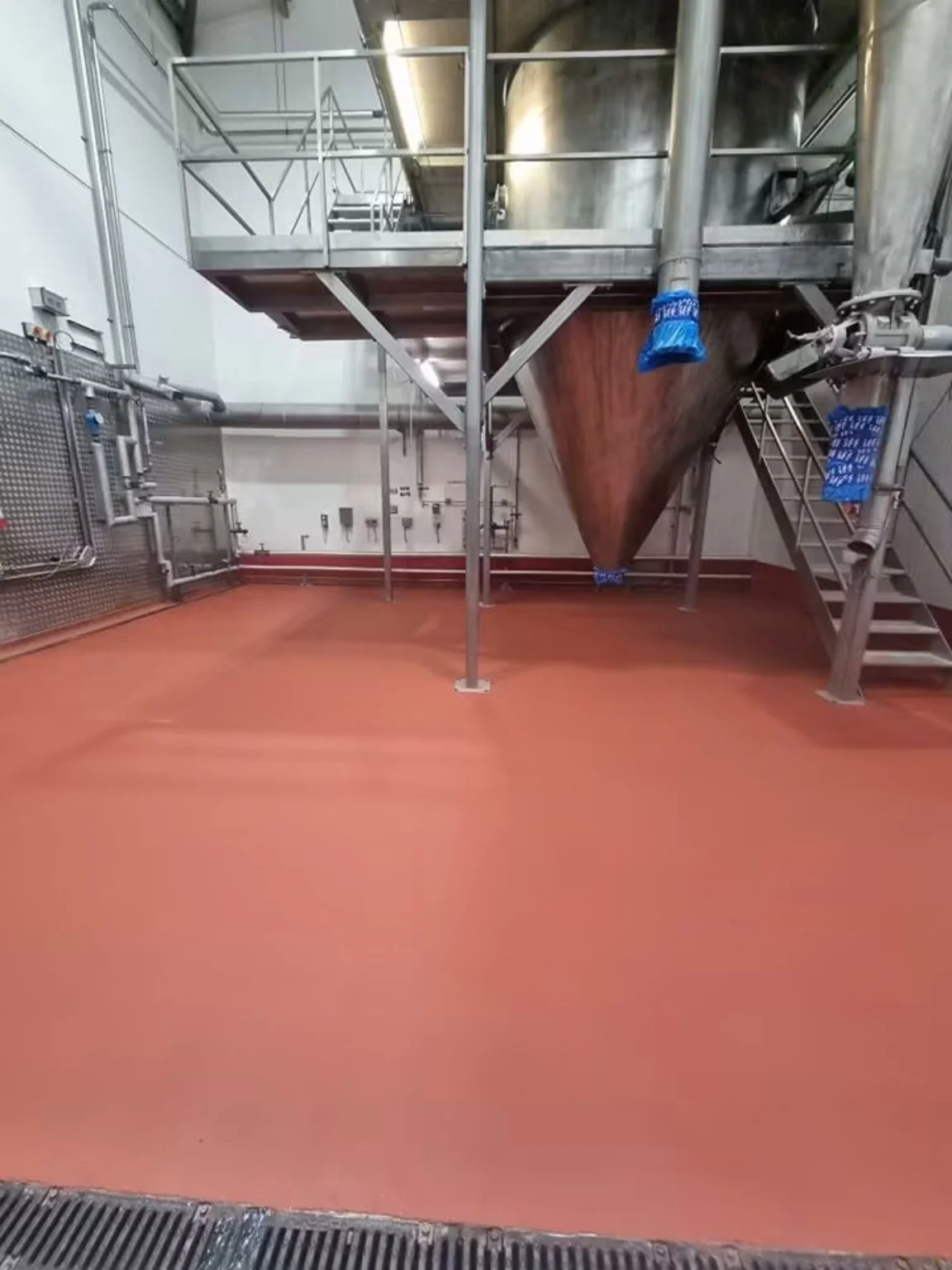
food-processing facility.
SRS completed a 120m² flooring refurbishment for Express Contract Drying Ltd
in Ebbw Vale.
The existing damaged and stained floor was removed to expose the concrete
beneath.
The concrete was found to be in reasonably good condition and was mechanically
prepared by diamond grinding before the new resin flooring build began.
SRS installed:
- 6–9mm Resdev Pumadur HF heavy-duty PU screed
- RAL 3001 red finish
- approximately 55 linear metres of resin coving
- a coordinated 600mm red perimeter band
The flooring system was selected around the area’s hygiene requirements,
hot-water exposure from the processing environment, chemical exposure and
the need for long-term durability.
The complete package was delivered in three days.
Read the full
Ebbw Vale Food Processing Flooring Case Study
.
One facility, several flooring demands
A food factory does not necessarily need PU screed everywhere
One of the biggest specification mistakes is assuming the entire facility
needs the same floor.
A practical food factory might contain:
- wet processing
- hot washdown areas
- dry packing rooms
- cold stores
- warehouses
- loading bays
- corridors
- staff and service areas
Those zones can have completely different traffic, temperature, cleaning
and contamination requirements.
A heavy-duty PU screed may be justified in the processing area while a suitable
epoxy system could be more appropriate in a dry warehouse or packing zone.
The objective should be to match the resin system to each operational area
rather than overspecifying or underspecifying the entire facility.
Preparation first
Neither epoxy nor PU screed will compensate for a poor substrate
The condition of the concrete remains critical regardless of which resin
technology is selected.
Before installation, potential issues can include:
- old failed coatings
- weak concrete
- oil and grease
- food contamination
- cracks
- damaged joints
- moisture
- holes and damaged areas
Mechanical preparation may include diamond grinding, shot blasting or another
method appropriate to the substrate and selected flooring system.
Read our
Industrial Floor Preparation and Repairs
page.
Independent industry guidance
Food flooring should be selected around the actual operating conditions
FeRFA’s synthetic resin flooring selection guidance recommends considering
traffic, impact, chemicals, cleaning and sterilising agents, temperature,
food-industry hygiene requirements, slip resistance, floor thickness and
available curing time.
It also recommends considering the age, condition and previous use of the
substrate because these factors can affect adhesion and preparation.
This supports the principle behind PU screed vs epoxy flooring selection:
the right floor is the one that suits the site’s actual service conditions.
View FeRFA’s Guide to the Selection of Synthetic Resin Flooring
.
Budget and lifecycle
Is PU screed more expensive than epoxy flooring?
It can be more expensive as an initial flooring build, but the comparison
needs to be made against the actual duty.
Cost is influenced by:
- floor condition
- preparation
- repairs
- system thickness
- coving
- drainage details
- anti-slip texture
- floor area
- access
- shutdown time
Installing a cheaper flooring build that is not appropriate for hot washdown,
chemicals or heavy food-production conditions can create a false saving.
Equally, installing a heavy PU screed in a simple dry storage room may be
unnecessary.
Read our
Resin Flooring Cost Guide
.
Planning a food factory floor?
Tell SRS how the room operates before choosing the resin system
These details help identify whether epoxy, PU screed or another resin flooring
route is worth assessing.
Continue your research
Related food and industrial flooring information
Frequently asked questions
PU screed vs epoxy flooring FAQs
Is PU screed better than epoxy for food factories?
PU screed is often better suited to demanding wet, hot-wash and chemically
exposed food-production areas. Epoxy can still be appropriate in dry packing,
storage and other areas with less severe operating conditions.
Can epoxy flooring be used in a food factory?
Yes. Suitable epoxy systems can be used in selected food-factory areas,
particularly dry storage, packing and lower-temperature spaces. The exact
system should be chosen around cleaning, chemicals, traffic and substrate conditions.
Why is PU screed used in food production?
Heavy-duty PU screed is commonly used because demanding food-production
environments can combine hot cleaning, water, chemicals, impact, traffic and
hygiene requirements.
Does PU screed withstand hot water?
Heavy-duty PU screed systems are available for high-temperature and hot-wash
environments, but the allowable temperature depends on the exact product and
thickness. Manufacturer guidance should always be checked.
How thick should PU screed be in a food factory?
There is no one correct thickness for every food factory. Thickness should be
selected around temperature, chemicals, impact, traffic and the manufacturer’s
system specification.
Do food factory floors need coving?
Coving is commonly used in hygiene-sensitive areas because it creates a more
practical floor-to-wall transition for cleaning. Whether it is required depends
on the room design and hygiene specification.
Does a food factory need anti-slip flooring?
Slip resistance should be selected around water, oils, food contamination,
cleaning methods and footwear. More texture can also make cleaning harder, so
grip and cleanability should be balanced.
Can epoxy and PU screed be used in the same food factory?
Yes. Different operating zones can legitimately require different flooring
systems. PU screed might be used in wet production while epoxy is used in dry
packing or warehouse areas.
Food factory resin flooring
Choose the flooring around the process, cleaning and temperature
Send Superior Resin Solutions photographs, floor area, cleaning regime,
temperature exposure, chemicals, drainage, traffic and available shutdown
time. We can discuss which flooring system is appropriate to assess.